
The talks leaders remember on Monday.
Clinically grounded keynotes on burnout, pressure, and leadership — from a trauma therapist who has spent 18 years inside both the boardroom and the therapy chair.
Every talk below can be delivered as a keynote or a hands-on workshop — in person or virtual.
The Silent Cost
Burnout is a leadership signal — not a wellness problem.
Burnout rarely announces itself. It hides as presenteeism, quiet quitting, and top performers who look fine right up until they resign. Nearly one in three employees is burning out silently while still hitting their numbers — the dashboard says everything's fine until the resignation letter says it isn't. Drawing on 18 years as a trauma therapist and corporate leader inside HSBC, Google, Accenture, and Cisco, Madhuri reframes burnout as early operational data — a leading indicator leaders can learn to read months before it becomes attrition — and hands managers the language to name it before it costs them their best people. This isn't a wellness talk. It's a clinical read on a business risk hiding in plain sight.
- Spot silent burnout months earlier, before the resignation
- Treat burnout as a business risk, not an HR footnote
- Equip managers as the organization's first early-warning system
- Name the pattern out loud, without shame or blame
- Who it's for
- CHROs, People and L&D leaders, executives, and managers responsible for retention, performance, and culture.
- Format
- Keynote (45–60 min) or half/full-day workshop · in person or virtual.
Four more talks. Same template. Same clarity.
You Are Not Your Chaos
Staying clear when the stakes say panic.
When pressure hits, the brain misreads it as identity — leaders start reacting as if the emergency is who they are, and the whole room follows. Madhuri shows audiences the one trainable skill underneath every high-pressure decision: step back, observe the chaos instead of becoming it, and choose the response. Not motivation — a clinically grounded method leaders can use the same week.
- Catch the pressure-to-panic loop before it drives the decision
- Separate signal from reaction, in themselves and their teams
- Lead and communicate from intention instead of adrenaline
- Return to clarity under real load, not just in theory
- Who it's for
- C-suites, boards, and leadership teams operating under sustained, high-stakes pressure.
- Format
- Keynote or workshop · in person or virtual.
The Empathy Edge
Empathy isn't soft. It's how leaders stay effective when pressure rises.
Empathy gets filed under 'nice to have' — until a negotiation stalls, a key hire walks, or a conflict spreads across a team. Madhuri makes the clinical case for empathy as a hard performance skill: the lever that shortens conflict, protects retention, and keeps decisions clean under pressure. Audiences leave able to deploy it deliberately — as a tool, not a temperament.
- Use empathy as a deliberate move in negotiation and conflict
- Keep their best people through the moments that usually lose them
- Defuse tension before it becomes turnover
- Lead difficult conversations without escalating the room
- Who it's for
- People leaders, sales and client-facing teams, and executives managing high-stakes relationships.
- Format
- Keynote or workshop · in person or virtual.
The Focused Brain
Attention is the executive's only real asset. Here's how to protect it.
Every leader runs on one thing: a clear head. Under long, high-stakes cycles, that's the first thing to go — and decision quality goes with it. Grounded in the neuroscience of focus, recovery, and cognitive load, this talk gives leaders a practical way to protect attention through the exact conditions that erode it. For neurodivergent leaders, it reframes the wiring most workplaces treat as a problem into a genuine strategic edge.
- Protect focus and decision quality under sustained pressure
- Recognize cognitive overload before it degrades judgment
- Build recovery into the workday, not just after burnout
- Turn ADHD and neurodivergent wiring into an advantage, not a liability
- Who it's for
- Founders, operators, executives in high-tempo roles, and neurodivergent leaders.
- Format
- Keynote or workshop · in person or virtual.
Honoring with Heart
Building belonging for the people who carry the most — seen and unseen.
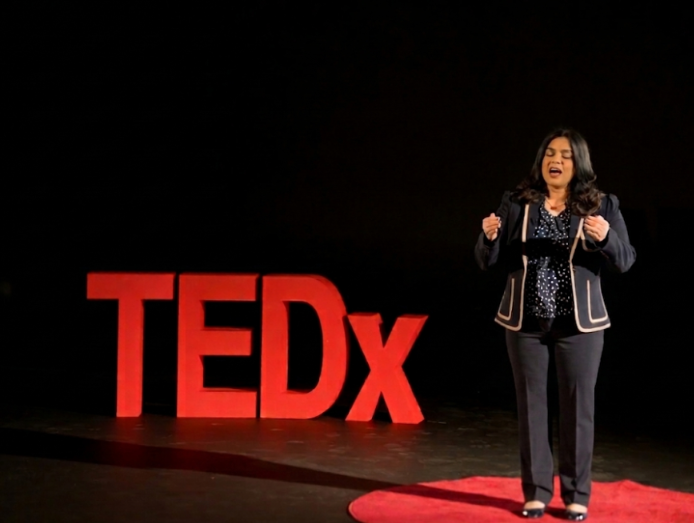
Every workforce runs on people managing something the room can't see — service and its aftermath, caregiving, chronic illness, grief, neurodivergence, the quiet weight of being the only one like them in the room. Trauma-informed and built from two decades of clinical work with veterans, MST survivors, and abuse survivors, this talk takes the hardest-won lessons about leading people under invisible load and turns them into a practical model any organization can use to build real belonging — not the poster kind, the kind people actually feel. Madhuri, a TEDx speaker and award-winning author for the veteran community, shows leaders how to create cultures where difference is safe, disclosure isn't a risk, and people don't have to keep their guard up to keep their job.
- Build psychological safety that holds across difference — background, ability, service, identity
- Support employees carrying invisible weight without singling them out or lowering the bar
- Turn 'belonging' from a statement into a set of leadership behaviors people can feel
- Recognize and reframe lived experience — veteran, neurodivergent, or otherwise — as leadership capital
- Who it's for
- ERGs, DEI and belonging councils, veteran-serving organizations, and mission-driven teams building cultures where everyone can do their best work.
- Format
- Available as a keynote or workshop · in person or virtual.
Every keynote becomes a working session.
Prefer hands-on to a stage? Any talk above converts into a half or full-day workshop — frameworks, drills, and decision tools your team takes into Monday, not just notes from a nice talk.
The rooms that shape organizations.
Executive audiences ready for depth, not surface motivation.
Company-wide moments where culture is reinforced or quietly eroded.
Standing-room stages where credibility is earned in the first 90 seconds.
Employee-led spaces where belonging and business outcomes meet.
Stages, associations, and mics.
People Patriot Project · Unscripted Conversations · Healing Hunnies
“Burnout isn't a personal failing. It's a system asking to be redesigned.”
The practical questions.
Bring the talk your leaders will still be using on Monday.
You are not your chaos. You're the one watching it.